Culture
The Last Periptero.
Two square metres, open at 3am, named after a temple. Athens' smallest building type is being subtracted from the city — a note on what remains.
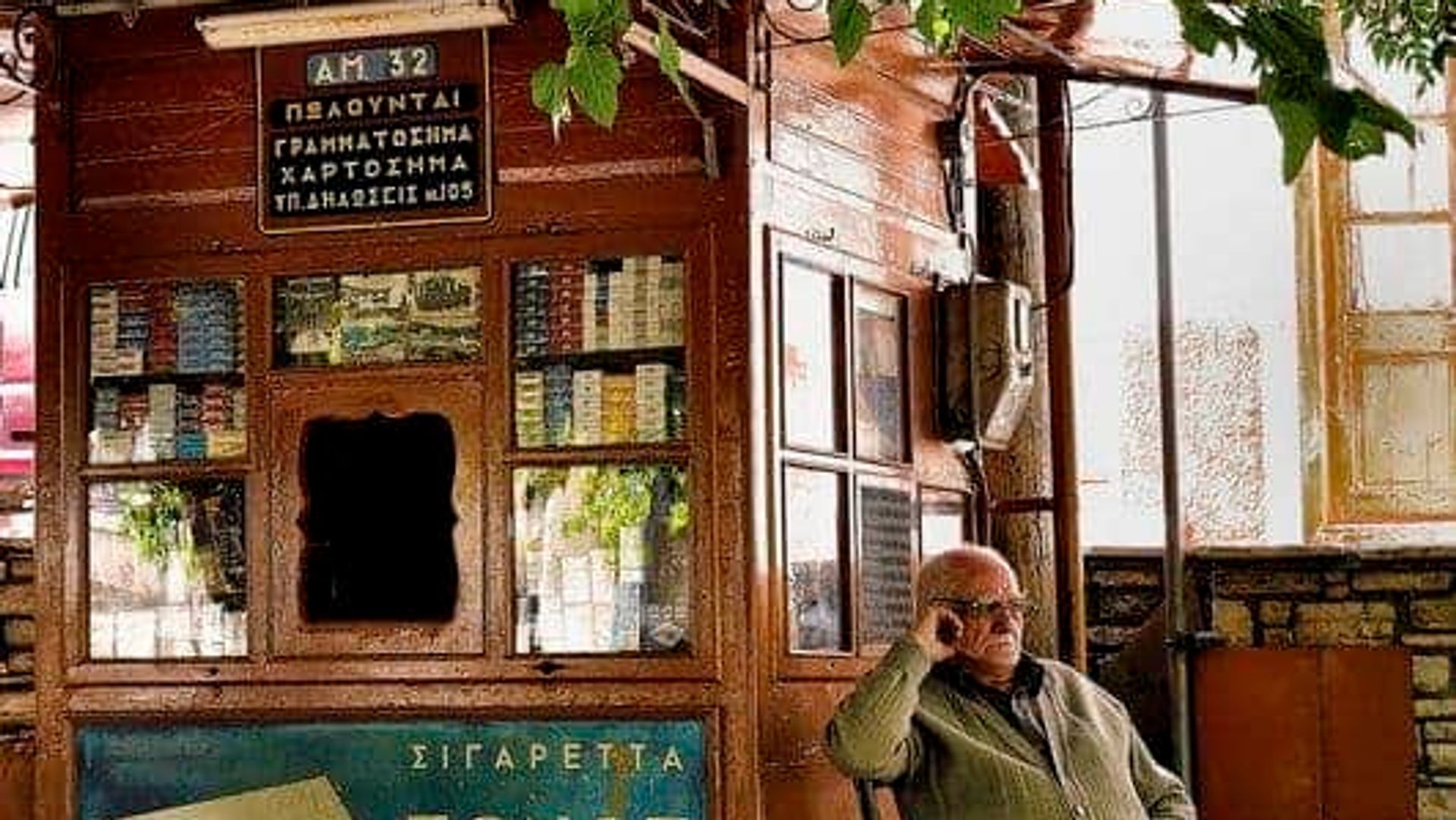
It measures 1.3 by 1.5 metres. One door at the back, three windows, a canopy, a fridge humming at the kerb. It sells water, cigarettes, painkillers, phone credit, chewing gum, and — at three in the morning, when everything else has surrendered — the last cold beer in the neighbourhood. The periptero is the smallest building in Athens. It is also, per square metre, the most used.
A Temple, Technically
The name is not casual. In classical architecture, a peripteros is a temple whose inner chamber is wrapped in a colonnade — the Parthenon is one. At some point in the early twentieth century the word migrated from the Acropolis to the street corner, from the largest architectural idea Greece ever produced to the smallest. The logic is structural: a roof carried on posts, a guarded interior, one attendant. The kiosk earned its name.
1911, Panepistimiou
The first one appeared on Panepistimiou Street in 1911 — a wooden canopy selling tobacco and newspapers. It stood for 86 years, until construction on the nearby metro line brought it down in 1997. Nobody was hurt. Everybody noticed the omen.
From 1922 the licences were an instrument of welfare. The state granted them to soldiers wounded between 1912 and 1921 — a decade in which Greece fought the Balkan Wars, the First World War and the campaign in Asia Minor, in that order. A man who could no longer work a field could sit in a wooden box and sell cigarettes. The licence could not be sold. It could be inherited — by the widow, by the children. The state got something in return: a tobacco-tax network with almost no overhead. The periptero was social policy disguised as retail.
The Switchboard Years
By mid-century the kiosk was infrastructure. In the 1950s and 60s, when a home telephone was a rarity, Athenians placed their calls from the rotary phone at the corner kiosk. "I'm calling from the periptero" was how conversations began. Sunday papers hung from the roof by clothes pegs and were read standing, hands clasped behind the back. Refrigerators arrived in the 1970s; cold drinks and ice cream followed.
One kiosk got away. In 1934, Giannis Georgakas ran a stand at the corner of Stadiou and Patission and called it Minion. He added pens, sunglasses, razors. Twenty years later Minion was a department store with a thousand employees and the first escalators in Greece. Every kiosk owner in Athens knows this story. It is the sector's single myth of escape.
The Long Subtraction
The decline has dates. In 1981, the year Greece entered the European Community, ageing licence holders were permitted to rent their kiosks to civilians; the box and its owner began to separate. In 2009 the crisis arrived, and hundreds of Athenian kiosks closed in the years that followed. In 2014, licensing passed to the municipalities and most new licences went to the open market. In 2015, an omnibus bill ended the inheritance: when a holder dies or closes, the licence dies too. No renewal, no transfer.
The arithmetic since is a subtraction with no addition column. Around 18,000 periptera stood in Greece in 2005. Fewer than 5,000 remain. Athens once counted more than a thousand; roughly 500 are left, and the law guarantees the number only falls.
The Ones Still Standing
The survivors cluster where foot traffic still justifies an eighteen-hour day: Kolonaki, Exarcheia, the squares around Syntagma and Omonoia. Many are run by the second generation — a daughter, a nephew, someone who did their homework inside the cabin and never fully left it. The stock has migrated with the city: phone chargers where the payphone was, delivery stickers on the glass, a card reader since the law required one in 2023.
A city is measurable by what you can get at 3am within 200 metres of your bed. By that measure, Athens is still — barely — ahead.
There is no preservation order for periptera. They are not listed buildings; legally, most are not buildings at all. When one closes, the cabin is unbolted and trucked away within days, and the pavement heals over as if nothing had stood there for ninety years. The temple's colonnade goes back to being a word.
Walk past one tonight. Buy something small — gum, water, the paper if there still is one. Not out of nostalgia. Out of accuracy: it is the correct place to buy it, at that hour, at that distance. It has been since 1911.