Yannis Tsarouchis Foundation.
The house a great Greek painter built to work in, with his studio rebuilt as he left it.
Edited by Aki Sumawaki
Artist's House & Studio
Since 1981
The painter's own 1965 house and studio, a protected monument
Yannis Tsarouchis built this Marousi house as his home and studio and later turned it into his own museum. Full-size copies, archive photographs and his personal objects bring back the room where his sailors and soldiers were painted.
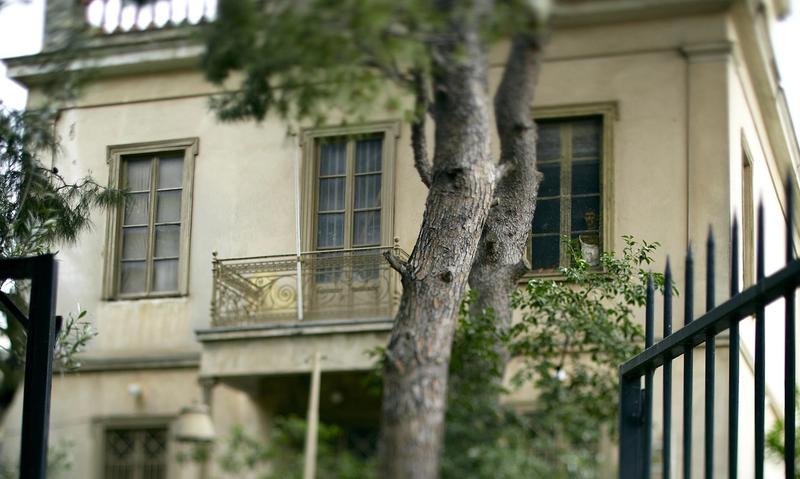
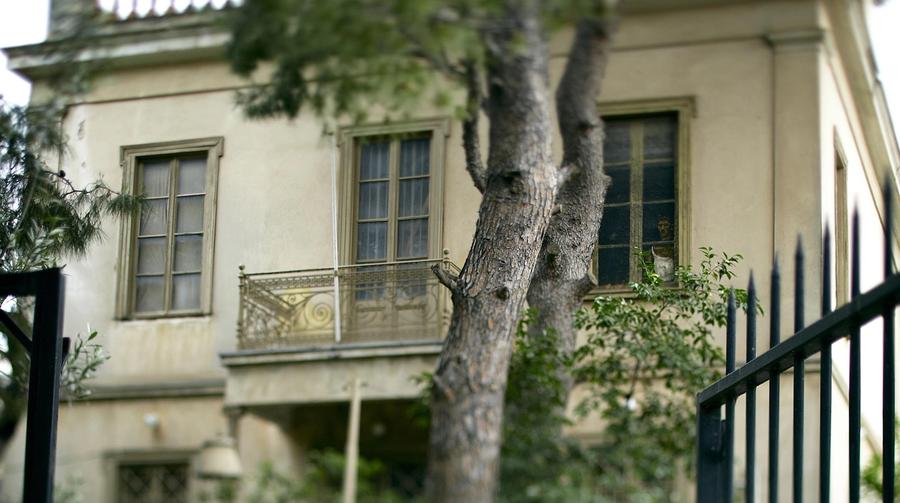
On a quiet street in Marousi, behind a garden gate and a few tall pines, stands a neoclassical-looking house that is not quite what it seems. Yannis Tsarouchis built it in 1965 as his home and studio, and for the last decades of his life it was where he painted, photographed his models and received his friends. Today it is the museum of the foundation he set up himself.
Tsarouchis, born in Piraeus in 1910 and one of the great Greek painters of the twentieth century, had long wanted space. "Finally, I had a plot," he wrote; he needed a studio not out of vanity but because he felt the need to make large-scale works. He lived on the ground floor and worked upstairs, on the first floor and in the room on the roof, where two skylights bring in the light he used for painting and photographing the young men who posed for him: sailors, soldiers, neighbours and friends.
I felt the need to make large-scale works. — Yannis Tsarouchis
In 1981 he created the Yannis Tsarouchis Foundation and turned those upper floors into exhibition rooms. He called the house "the Museum of Marousi" and curated its shows himself; it first opened to the public in 1982. He presided over the foundation until his death in 1989, and he left it some 5,000 of his works, the house and his archive. The building has since been declared a protected monument, and the foundation holds the copyright to his entire output, from paintings and drawings to his writing, translations and stage designs.
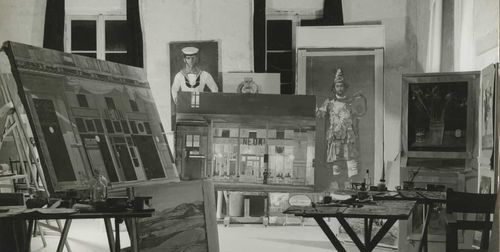
What you see now is a reconstruction of the studio as he left it, based on his own photographs. Since the originals cannot be pinned to walls or propped on the floor, full-size copies are shown the way he arranged his work, against walls hung with cloth, beside his personal objects and archive photographs. The effect is intimate rather than grand: you understand how he handled light and shadow, how he staged a composition, and how the coffee-houses, the soldiers and the sailors of his paintings were built from real people in this very room. The upstairs rooms also host changing exhibitions, from his theatre designs and unpublished studies to shows of the artists in his circle.
The visit is short, two rooms and an attic, so give it an hour and pair it with a walk around old Marousi. On the ground floor is a small shop with prints, posters and books on Tsarouchis that are hard to find elsewhere. The foundation also published the catalogue of the Chicago exhibition "Dancing in Real Life", which The New York Times named among the best art books of 2021.
Plan around the timetable: the museum is open on weekday mornings only, closed at weekends, on national holidays and for the whole of August, so check before you go. Admission is 5 euros, and free for under-18s and art students. The foundation points visitors to KAT station on metro line 1, the green line; the A8 bus stops at the Amarousiou town hall, and bus 020 has a stop named after the museum.
Why we picked it
Big museums show you the finished paintings; this one shows you how they were made. It is small, slightly out of the way and open only on weekday mornings, which is exactly why it feels like a private visit.
Best forArt lovers who want to see where Tsarouchis actually worked