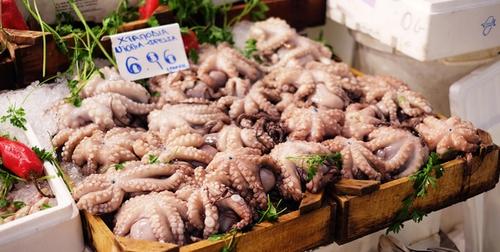
Athens Central Market.
Fish on one side, meat on the other. Wake up early.
Edited by Aki Sumawaki
Fish, Meat & Produce Market
Since 1886
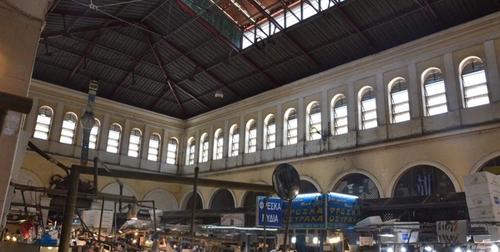
Iron and glass neoclassical, 1886
~5 min walk to Psyrri Square
~6 min to Omonia Square
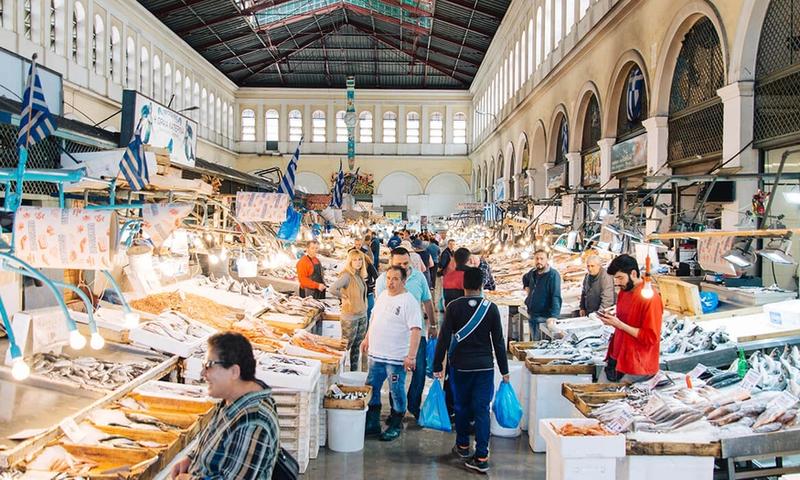
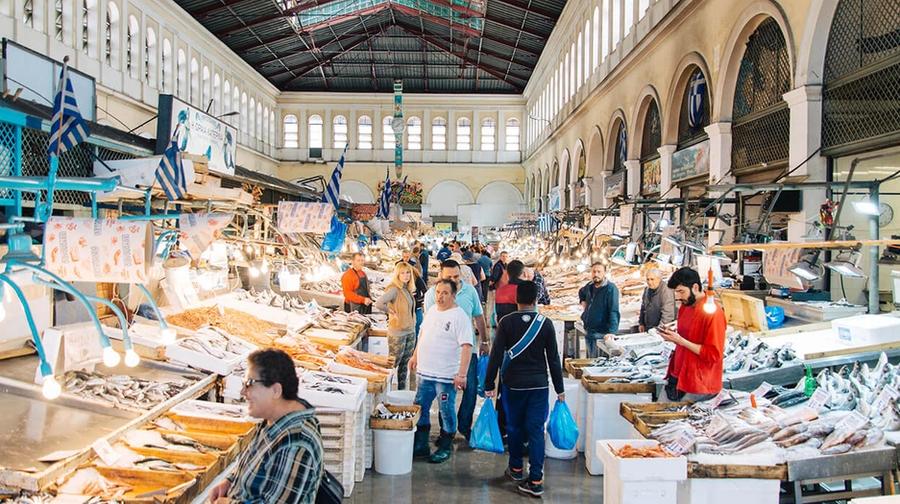
The Varvakios Agora, the city's central food market under one long iron-and-glass roof, named after the benefactor Ioannis Varvakis. Fishmongers, butchers and greengrocers, with chefs and grandmothers in the same queues and small tavernas tucked between the stalls.
Halfway down Athinas Street, between Omonia and Monastiraki, you smell the market before you see it. The Varvakios Agora is the city's central food market and still its busiest kitchen: fish and meat under one long iron-and-glass roof, fruit and vegetables across the street, and a ring of small shops selling everything else a Greek household cooks with.
It began as a solution to chaos. In the late nineteenth century, vendors sold from improvised shacks below the Acropolis and around the Roman Agora. Planning for a proper covered market started in 1876, money came from the benefactor Ioannis Varvakis, a caviar importer whose name the market still carries, and the hall with its glass roof was finished in 1886. Locals simply call it Varvakios, or Dimotiki Agora, the municipal market.
Everything is sold by the kilo, including the noise.
Walk in from Athinas and the fish hall opens up in front of you: long counters under the skylights, fishmongers shouting prices, crates of sea bream, red mullet, hake and grouper on ice. Much of the catch comes in from the islands, from Naxos, Paros, Skyros, Kalymnos and Symi, and This is Athens calls it the largest fresh fish market in Europe. What is on the ice changes with the season, so ask what came in that morning; they will clean and pack your fish for you. Turn the corner and you are in the meat market, where butchers hang whole lambs and goats and sell every cut from steak to tripe and feet, the raw material of patsas, the tripe soup Athenians swear by after a long night.
Cross Athinas for the fruit and vegetable market, where almost everything is sold by the kilo: olives, pickles, cheeses, pulses, salted cod, herbs and whatever is in season. The streets around it, Sofokleous, Armodiou and Evripidou, are worth the detour: stalls of nuts, dried fruit and spices, egg shops like Krokos with everything from quail to ostrich eggs, honey and beeswax, island groceries, and Arkas Batanian's deli with Anatolian-style cured meats and sausages. On Armodiou, the Tsoupakis family has sold fruit and vegetables for more than fifty years and opens at five in the morning.
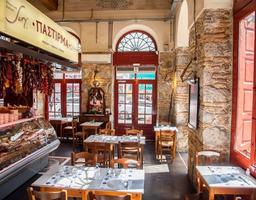
Then eat. Tucked into the market itself, Karayiannis serves ouzo with meze: marinated anchovies, smoked mackerel, mussels and spicy lamb meatballs. Aris, on Sofokleous, will grill the fish you just bought for a small fee if you order a couple of dishes with it. Epirus, on Filopimenos, is the workers' canteen of the area, famous for its patsas and daily pots of soup and stew. For coffee, the old Mokka roastery at Athinas 44 still brews Greek coffee in hot sand.
Go early, ideally before nine, when the fish is freshest, the chefs are buying and the light falls through the roof. Wear shoes you do not mind washing, carry cash for the small stalls, and leave room in your bag. The market is closed on Sundays, and quieter in the afternoon.
Monastiraki and Omonia metro stations are each a few minutes' walk away along Athinas, so it is an easy stop between the Acropolis area and the centre.
Why we picked it
The loudest, most honest few blocks in Athens. Come early, follow the chefs, and finish with a plate in one of the tavernas between the stalls.
Best forEarly risers and anyone who cooks