Benaki Museum - Ghika Gallery.
A painter's house that tells the story of a whole generation.
Edited by Aki Sumawaki
Artist's House & Studio
Since 1932
Interwar Modernist
~3 min walk to Syntagma Square
~5 min to Kolonaki Square
Nikos Hadjikyriakos-Ghika gave his family's building to the Benaki Museum. The lower floors tell the story of the Generation of the '30s through art and personal objects; the top floors are his own work, his family apartment and his studio, kept as he left it.
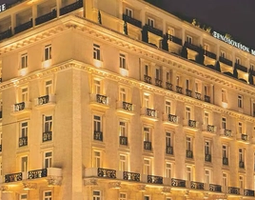
Kriezotou is a short, busy street running down from Kolonaki towards Syntagma, and number 3 looks at first like any other interwar apartment block. It was built in 1932 for Admiral Alexandros Hadjikyriakos, the painter's father, and To Vima credits the design to the architect Konstantinos Kitsikis. The admiral was its first resident. His son, Nikos Hadjikyriakos-Ghika, lived and worked here for about forty years, added a fifth-floor studio in the mid-1950s with the help of two of his students, and in 1989 gave the whole building to the Benaki Museum. He died in 1994.
Ghika, born in 1906, was a painter, sculptor, writer and academician, one of the central figures of what Greeks call the Generation of the '30s: the painters, writers, musicians and architects who brought European modernism home between the wars and gave it a Greek accent. When the Benaki opened the restored building as a gallery in 2012, after a long renovation, it chose to tell that generation's story through the house of one of its members.
The visitor who crosses this building's threshold will see the history of our country's intellectual and artistic life begin. — Angelos Delivorrias, former director of the Benaki Museum
The visit is arranged vertically, like a book you read from the ground floor up. The lower floors follow the period chronologically, from the Asia Minor Catastrophe of 1922 to the eve of the 1967 dictatorship, artist by artist, each introduced by the year of their birth. You meet the shadow-puppet master Sotiris Spatharis and his Karagiozis figures, the painters Fotis Kontoglou, Giorgos Gounaropoulos, Spyros Papaloukas and Yannis Moralis, the architect Dimitris Pikionis, the conductor Dimitri Mitropoulos, Manos Hadjidakis, Mikis Theodorakis and Michael Cacoyannis.
What makes it moving are the objects. There is the Lenin Prize awarded to Yannis Ritsos, papers connected with the Nobel Prizes of Seferis and Elytis, handwritten lyrics by the rebetiko musician Markos Vamvakaris, a 1936 letter from Yannis Skarimbas to Angelos Sikelianos, the beret of the novelist Dido Sotiriou, and, most startling of all, the revolver the poet Kostas Karyotakis used in 1928 and his last note.
Higher up, the building becomes Ghika's own. One floor shows his paintings, drawings, sculptures and stage designs, partly in the gallery arrangement he made himself in 1991. Above it is the family apartment: the living room, the dining room with his painting of Kifisia, and his father's study with the admiral's library and papers. At the top is the studio, kept as he left it, with its high windows, easel and bookshelves; the only addition is a glass case for his brushes, paints and tools.
This is not a blockbuster museum, and that is its strength. Give it an hour and a half, start at the bottom and resist skipping ahead. It is the best single introduction in Athens to the artists and writers who shaped modern Greek culture, and the top floors are as close as you will get to visiting a great Greek painter at home.
The gallery opens Thursday to Sunday only, with a late opening on Thursday, so plan around that. Syntagma metro station, on lines 2 and 3, is a five-minute walk away; Kriezotou starts just off Panepistimiou.
Why we picked it
The most intimate museum in Athens, and the best single introduction to modern Greek culture. Karyotakis's revolver on one floor, Ghika's easel a few floors up: no wall text could do it better.
Best forReaders, artists and the quietly curious